Back to projects

Remnants of Absence: Missing Origin

Jennifer Lee, Ceren Seckin, Annie Conron

This video-based installation examines abandoned, man-made sites through photogrammetric reconstruction. Physical space is approached as the bearer of subtle environmental residues that persist beyond the events and bodies that once occupied it. Through environmental sensing technologies, fluctuations register as signs of lingering impact. Threshold logic converts these deviations into moments of significance within an otherwise still space. In flickers, shifts, and glitches, disturbances resist fixation, operating as relational formations in the present rather than as remnants of the past. The absences of the past are mediated through the bodies and systems that seek them. What appears as haunting is not a return, but the persistence of trace within space, shaping the environments that are continuously authored by those who inhabit and experience them, and each act of presence reshapes the conditions through which space is sensed and reconstructed.

GitHub repository
Assets

Drive Link
https://drive.google.com/drive/folders/1-DXKpukIvsdbvtxX6xGcnFNV74aqKfuE?usp=sharing

Exhibition Video Essay
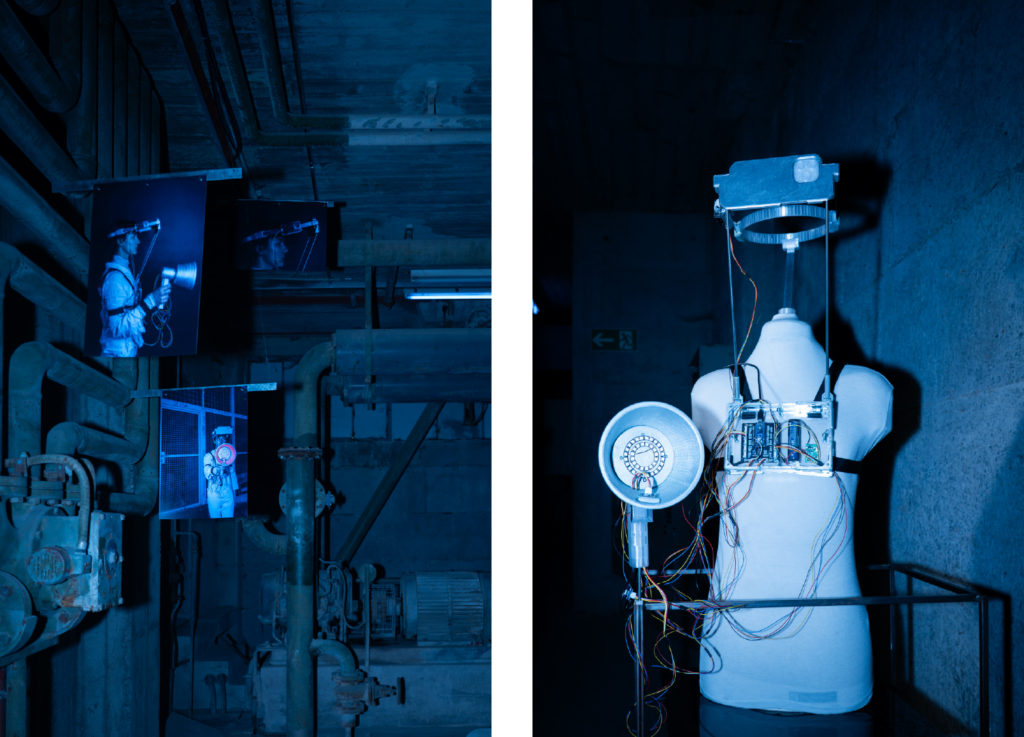
Photography and Device Display at SACEBA

Video Essay SACEBA

Photogrammetry LCD Display at SACEBA
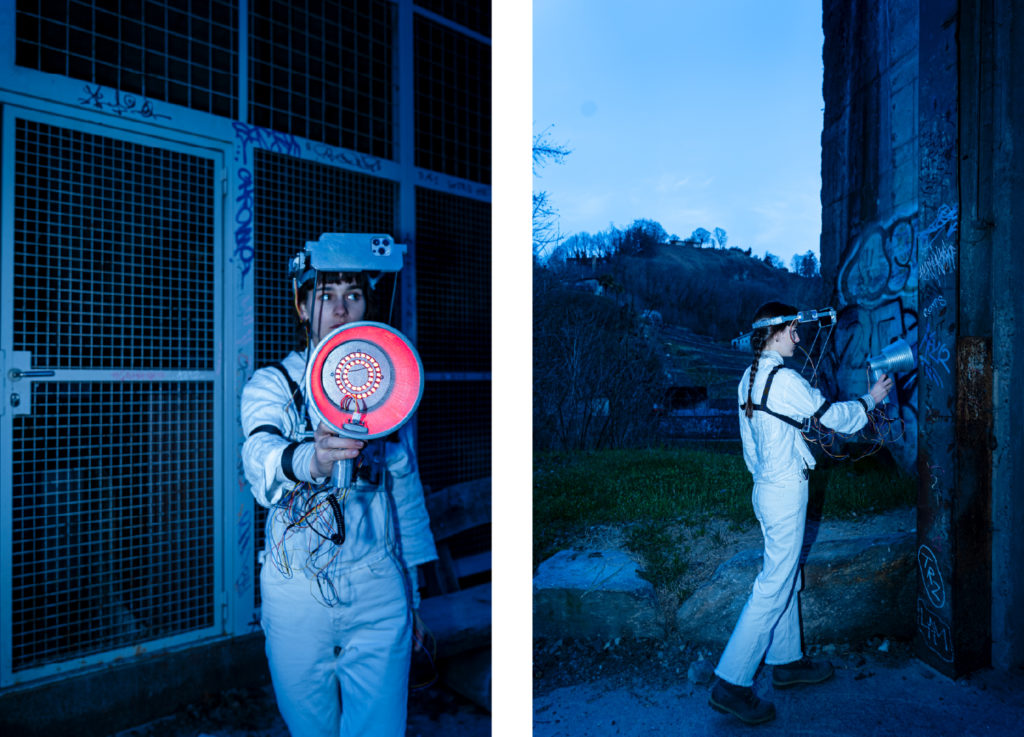
Photography of Exploration

Context

Remnants of Absence was developed within the Camera Magica workshop at SUPSI MAInD, part of the broader project Shadow Creatures, co-produced by Fotomuseum Winterthur and Kutxa Fundazioa. The brief asked for speculative camera systems that reveal non-human ways of seeing, conceived for a museum context. This work responds by treating environmental sensing and photogrammetric reconstruction as a method of making invisible occupational history perceptible.

Photogrammetry Reconstruction Result of Three Scenes

Concept

This work does not begin with what is present, but with the difficulty of locating it. A space can appear stable, continuous, self-contained. Yet the conditions that shape it are not fixed. They are continuously altered. By movement, by occupation, by processes that do not leave clearly identifiable traces. What remains is not a record, but a state that has been subtly modified. Rather than attempting to recover what has taken place, the project focuses on how such modification becomes perceptible. Not as a visible mark, but as a shift that cannot be fully accounted for. Something is registered, but it cannot be clearly attributed. The relation between cause and effect no longer holds. What is encountered is not evidence, but a condition in which something has happened without being locatable. In this context, absence is not a missing element, but the result of this gap. It is produced when a change is perceptible, but its origin cannot be resolved. The work remains within this condition. It does not attempt to clarify or complete what is sensed, but allows it to remain open, suspended between detection and attribution. What emerges is not a reconstruction of what was, but a space in which the limits of perception become visible. A space where something is registered, but cannot be fully known.

The Process

We began by questioning how presence and its absence can be perceived beyond what is visible. Rather than understanding space through what appears in front of us, we became interested in how environments register subtle variations that do not settle into identifiable forms, but persist as shifts within the conditions of a space.

This led us to consider how presence might be sensed indirectly, through shifts in temperature, humidity, and airborne particles. These traces do not exist as clear evidence, but as faint deviations within the environment. What remains is not the event itself, but its residual effect.

At the same time, we were interested in how such traces are perceived. A disturbance only becomes noticeable when it diverges from what is expected. This introduced the idea that absence is not simply given, but emerges through a relationship between what is sensed and what is assumed to be there.

From this, we began to define the system not as a tool for detection, but as a device that registers change without resolving its origin. Instead of identifying or classifying, the device operates through thresholds, marking moments where multiple environmental conditions shift simultaneously. These signals suggest presence, but do not confirm what produced them.

We also chose to integrate the body into the system. Rather than designing a standalone device, we developed a wearable sensing instrument that must be carried through the space. This allows physiological signals, such as galvanic skin response, to become part of the sensing process. The person scanning is therefore not separate from the system, but actively contributes to the conditions being recorded.

To translate these traces into a spatial form, we incorporated photogrammetric scanning. The environment is captured through movement and reconstructed as a digital model. This reconstruction does not replicate the site as it exists, but reorganises it through the path of sensing and scanning. Moments marked during detection, indicated by a red light, are embedded into the reconstructed space as areas of instability.

Through this process, the project shifts from documenting a site to constructing an archive of traces. The resulting environment does not reveal what happened, but presents where something was sensed as different. In this way, presence is registered through change, while its origin remains unresolved.
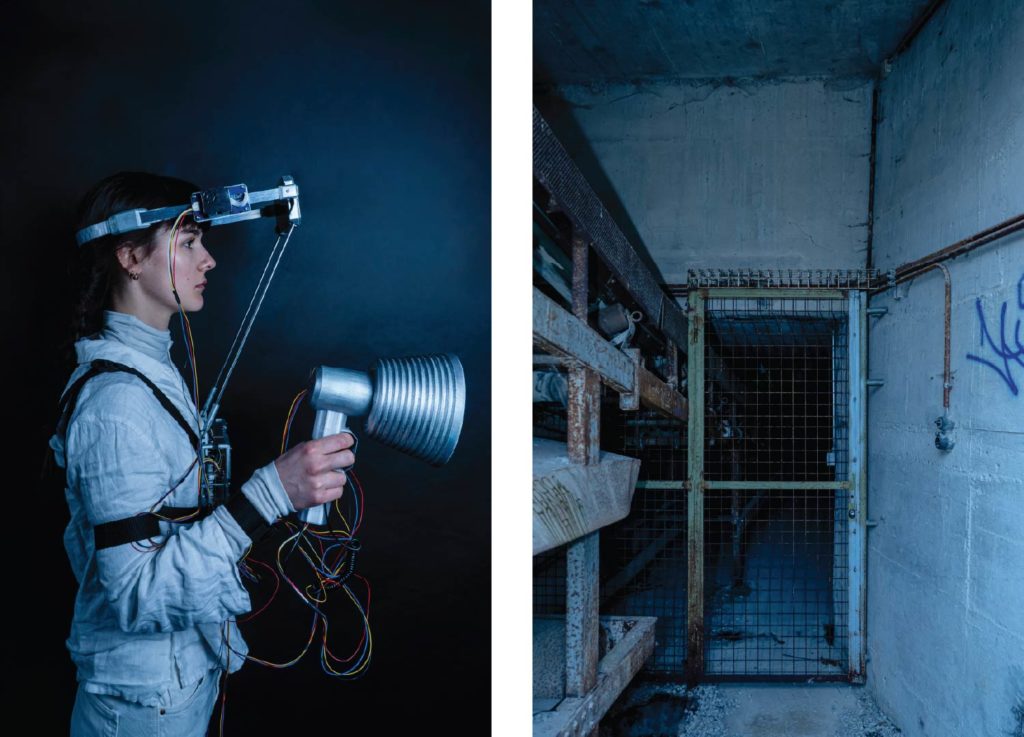
Device & Environment Scene 1 of Exploration

Research

The SLS Camera (Structured Light Scanner)
Used by paranormal investigators as a ghost-detecting device, the SLS camera applies depth-sensing technology to map skeletal figures onto undefined shapes in an environment. The device misapplies computer vision, and this misapplication has become a genre. Remnants of Absence borrows the methodology’s seriousness while replacing depth sensing with environmental sensing.
Tesla Autopilot in Cemeteries
Viral documentation of Tesla’s Autopilot system misidentifying tombstones as pedestrians is a moment when the gap between machine logic and human meaning becomes visible — and accidentally poetic. The anomaly detection logic in this instrument operates on similar territory: it cannot know what triggered the deviation, only that something did.
Ways of Seeing, John Berger
Berger proposes that seeing is not neutral, but shaped by prior knowledge, cultural context, and expectation. What becomes visible is always influenced by what is already known, meaning that perception operates through comparison rather than direct encounter. In Remnants of Absence, this idea informs how environmental deviations are registered: a disturbance becomes perceptible when it diverges from an assumed condition of the space. The system does not reveal presence directly, but produces moments that are interpreted as such.
Apparatus Theory, Vilém Flusser
Flusser describes technical images as products of apparatuses that structure what can be seen, rather than neutral recordings of reality. The apparatus operates through programmed logic, generating outputs based on its own conditions and constraints. In this project, the sensing device functions in a similar way: it does not capture the environment objectively, but produces signals through threshold-based detection. What emerges is shaped by the system itself, not by a direct correspondence to the site.
Musée Imaginaire, André Malraux
Malraux introduces the idea that reproduction detaches images from their original context, allowing them to be reorganised within new frameworks of meaning. Reproduction is therefore not an act of preservation, but of transformation. In Remnants of Absence, photogrammetric reconstruction operates in a similar way. The scanned environment is not reproduced as it exists, but reconfigured through sensing, movement, and detection. The resulting space reflects the conditions of its capture rather than the original site itself.

The Device

The Remnants of Absence Instrument is a wearable system comprising two components that operate in parallel. The Sensor reads the invisible environment through four channels. The Scanner records the visible space as a Gaussian Splat point cloud. Their outputs are brought together in post-processing, where the sensor data marks and destabilises the spatial scan.
The Sensor calibrates a 30-second environmental baseline on startup. During active sensing, it samples all channels every 2 seconds. When deviations converge simultaneously across channels, an anomaly is logged and the NeoPixel ring activates red. The Scanner captures the environment continuously via Luma AI on a mounted iPhone. The anomaly log is then imported into TouchDesigner, where flagged coordinates drive GLSL displacement of particles in the point cloud at those locations.

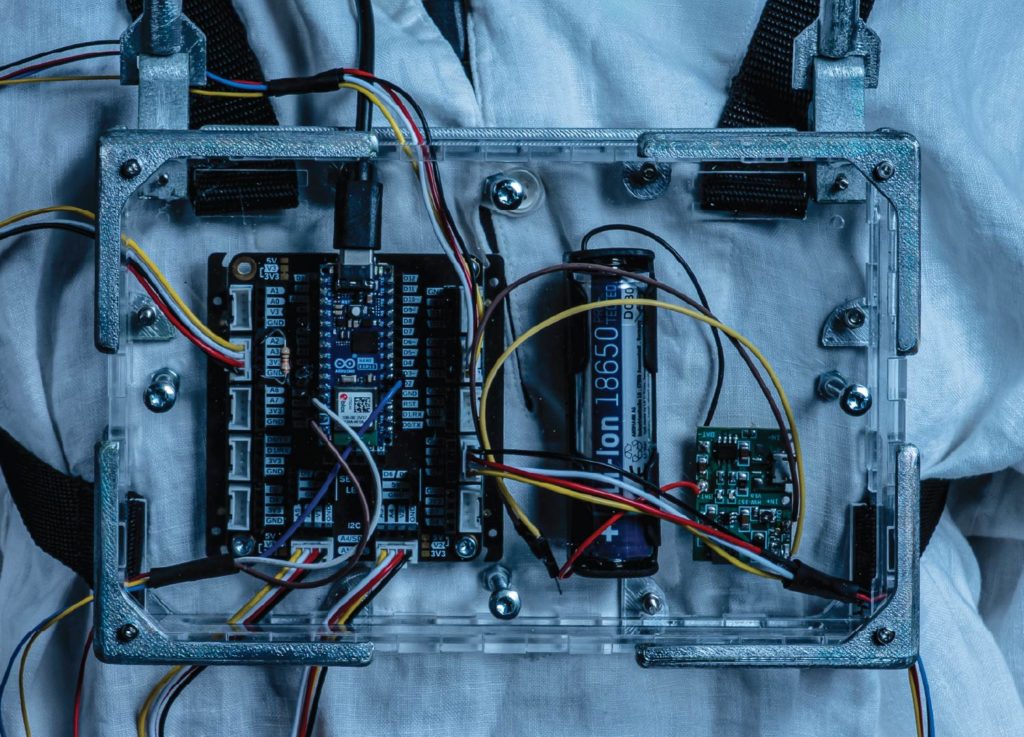
Chestplate

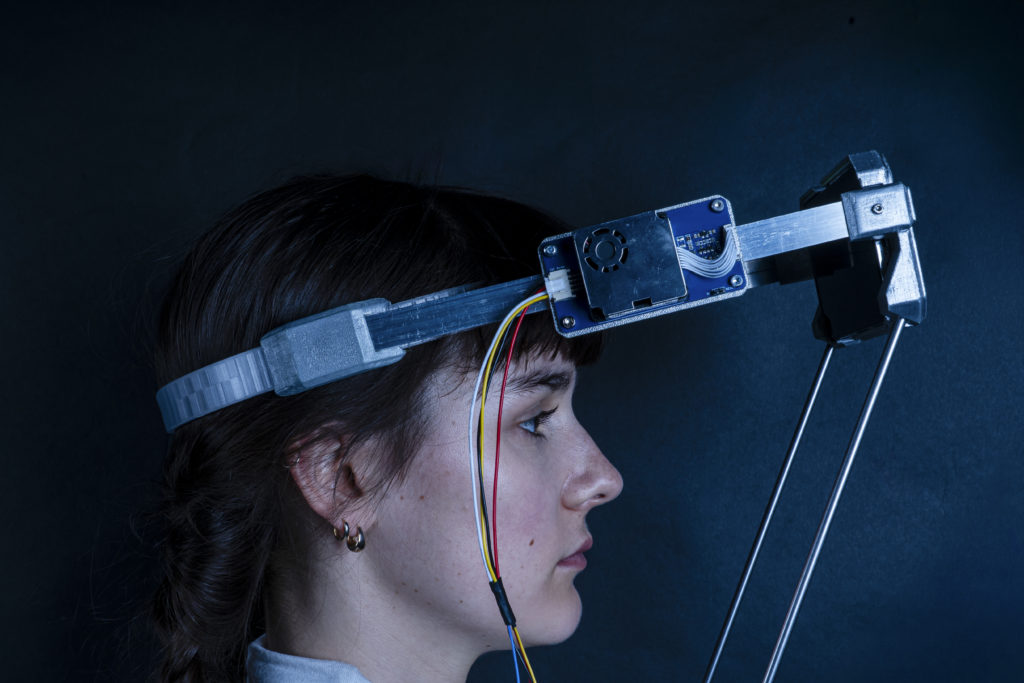
Device Headpiece

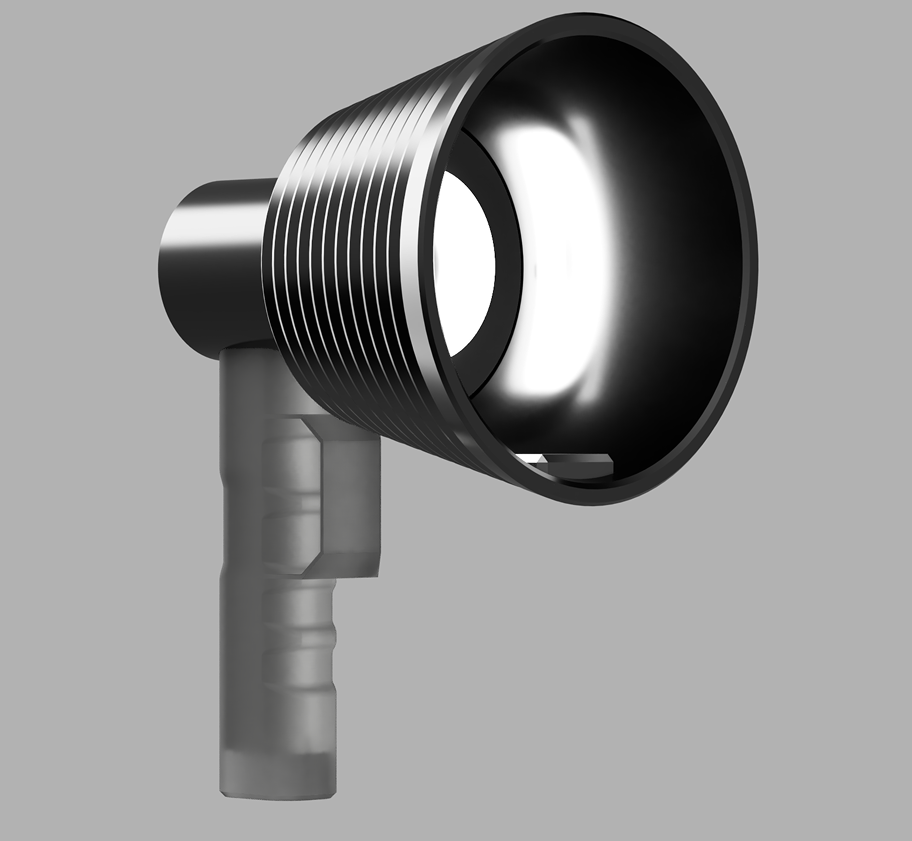
Handheld Device
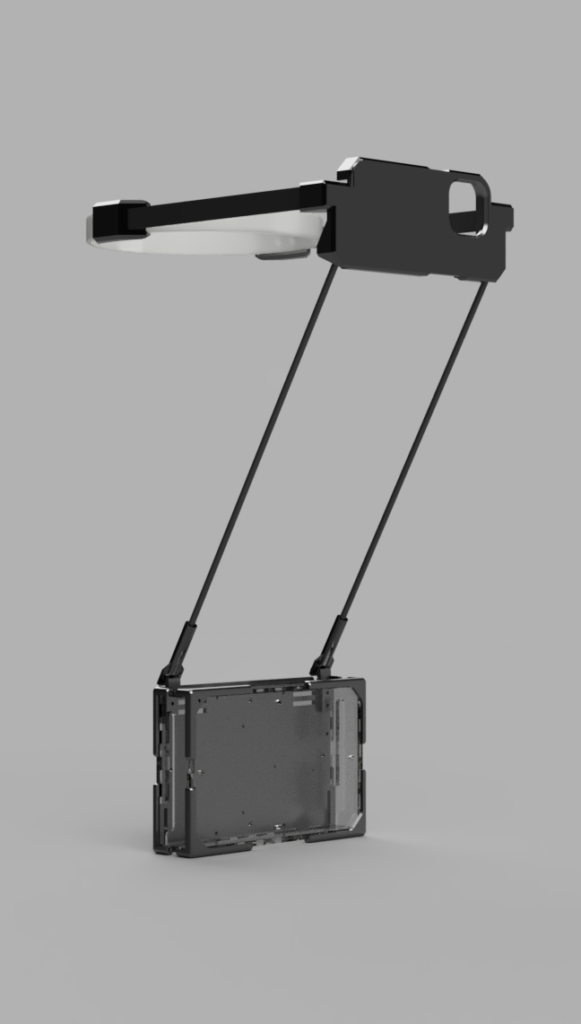
Headband & Chestplate

The Sensor

The Sensor is a handheld conical device with a funnel-shaped body fabricated from 3D-printed PETG and an integrated sensor housing. The funnel form suggests a horn or directional receiver — something pointed at a source, referencing the history of acoustic instruments designed to amplify what the unaided sense cannot reach.
The NeoPixel ring is mounted at the throat of the funnel, facing inward. When triggered, it illuminates the interior with a contained red glow visible from the front of the device. Wires run from the handle along the user’s arm to an electronics assembly worn on the chest, keeping all components visible as part of the device’s aesthetic.
Sensors
  • Galvanic Skin Response — Grove GSR v1.2: GSR measures skin electrical conductance. Here it is repurposed: direct contact on the handle makes the investigator part of the sensing circuit. The device reads not the internal state of the person, but the environment through them.
  • Temperature & Humidity — Adafruit AHT20: Bodies raise the temperature and humidity of the spaces they occupy. The sensor detects deviations of ±0.5°C and ±2% RH from the calibrated baseline — small enough to indicate recent biological presence rather than gross environmental shifts.
  • Particulate Matter PM2.5 — Seeed HM330X: Human occupation produces fine particulate matter — skin cells, fibres, breath aerosols — that persists in the air after a body has left a space. The sensor detects deviations of ±3 µg/m³ from baseline.
Electronics
  • Microcontroller: Arduino Nano ESP32
  • LED output: Adafruit NeoPixel ring (24 pixels), WS2812B
  • Power: USB via body-worn pack
  • Libraries: Adafruit NeoPixel, Adafruit AHTX0, Seeed HM330X
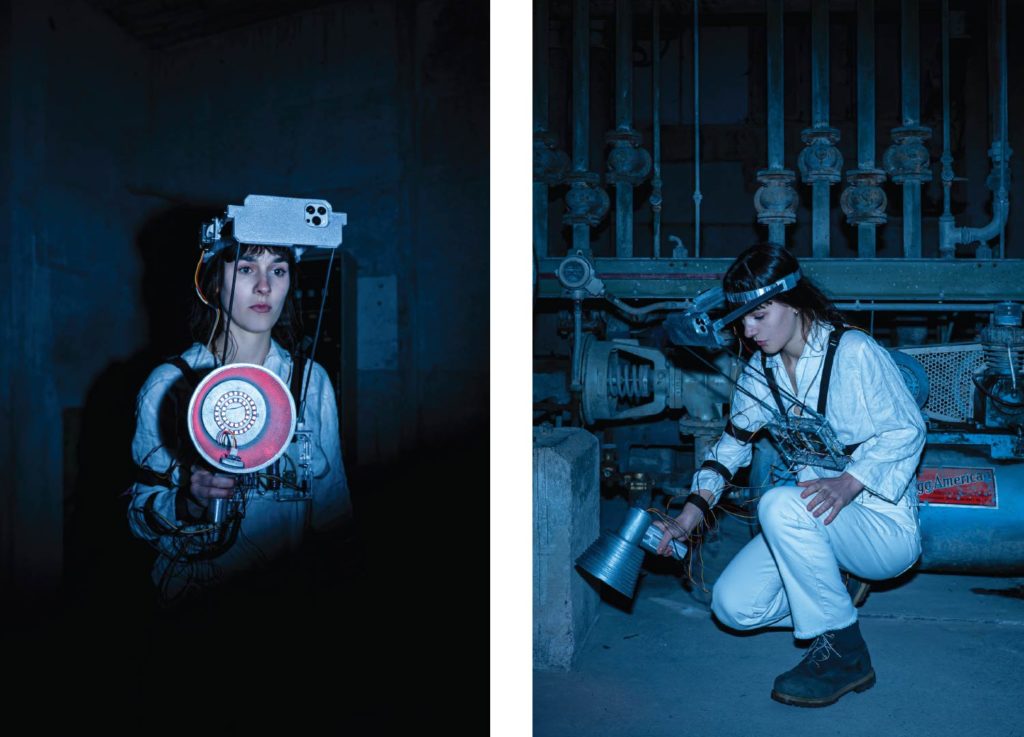
The Scanner

The Scanner is a head-mounted unit: a lightweight 3D-printed bracket worn as a headband, with two aluminium forward-extending arms holding an iPhone above the wearer’s eyeline. The phone runs Luma AI and scans continuously as the investigator moves through the space.
Placing the camera at head height aligns the scan approximately with the investigator’s gaze — the Scanner sees what the eye sees, but processes it as depth and geometry rather than image. Wires connecting the Scanner to the chest-worn electronics run across the body, making the link between the two components physically visible.

The Firmware

The sketch implements a three-state machine: `STATE_OFF`, `STATE_CALIBRATING`, and `STATE_SENSING`. In `STATE_CALIBRATING`, the LEDs illuminate green. Over 30 seconds the device samples all sensors and computes a running average baseline — the environmental normal of the space before investigation begins. In `STATE_SENSING`, the device reads all channels every 2 seconds and compares against baseline. An anomaly is flagged only when all three conditions are met simultaneously.
The simultaneous multi-channel threshold is a deliberate design choice. Any single-channel deviation could be noise. Requiring convergence across channels reduces false positives and gives the instrument’s claims a degree of internal consistency — without ever making them verifiable.

The Visualisation

The Gaussian Splat point cloud loaded into TouchDesigner provides the spatial substrate. Each vertex represents a sampled point in the scanned environment, carrying position and colour encoded as Spherical Harmonic DC coefficients.
The anomaly log from the Sensor provides a set of timestamped coordinate references. Particles at those locations are isolated and subjected to GLSL-based noise displacement — vibrating, drifting, or dissolving — while the surrounding geometry holds stable. The colour channel is also implicated: particles meeting a red threshold (the colour of the NeoPixel ring’s anomaly signal) are candidates for selective displacement, creating a visual correspondence between what the Sensor flagged and what the point cloud shows.
Three separate scans of different locations are rendered independently, each showing its own pattern of anomaly-driven disturbance.

The Installation

Remnants of Absence is presented as a video-based installation for a museum or gallery setting. The primary output is a narrated video essay that takes the viewer through the full arc of the work: the investigator moving through an abandoned industrial site wearing the Instrument, the Sensor’s red light illuminating at moments of detected anomalies, and the subsequent photogrammetric reconstruction rendered as a destabilised point cloud.
The video plays on a large central screen. Three smaller screens arranged alongside show looping TouchDesigner renders of three separate scanned locations, each a point cloud marked by its own pattern of sensor-driven displacement. Where the large screen shows process and narration, the smaller screens show the accumulated spatial record: the sites as the Instrument experienced them, held in a state of controlled instability.
The narration does not explain or interpret the data. It moves through the logic of the work without resolving the ambiguity at the centre of the instrument’s claims. The video ends not with a finding, but with a condition: absence reconstructed, briefly, as something perceptible.

References

  • Marco De Mutiis / Fotomuseum Winterthur — Shadow Creatures brief, Camera Magica workshop, SUPSI MAInD 2026
  • Trevor Paglen — Invisible Images (Your Pictures Are Looking at You) (2016): The New Inquiry
  • Jon Wood Science — The SLS Camera (2024): jonwoodscience.com
  • Steph Maj Swanson — Loab (2022): on the emergence of statistical ghosts in image generation models
  • Berger, J. (2008). Ways of seeing. Penguin Books
  • Flusser, V. (2000). Towards a philosophy of photography (A. Mathews, Trans.). Reaktion Books.
    (Original work published 1983).
  • Malraux, A. (1965). Le musée imaginaire. Gallimard.